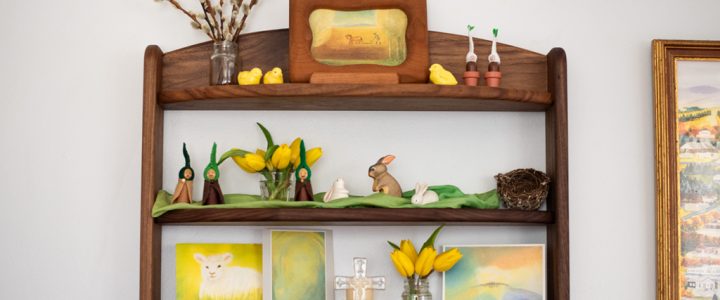
In May, there is no question about whether or not it’s spring. It’s the time for maypoles and flowers . . . everything is in bloom! This month is also dedicated to the Blessed Virgin Mary, so she gets a whole tier to herself.

I have two naughty (but adorable) cats, and they like to be overly involved with my season table. So I’m trying something new: A season shelf.
This beautiful shelf is from Camden Rose. I’ve designed the first two shelves to be more nature-focused, while the bottom shelf is dedicated to the liturgical year. But it all feels very cohesive, in part because the liturgical calendar is a reflection of Creation.
One thing I have learned on my seasonal- and liturgical-living journey is that it’s okay for things to change. Living seasonally isn’t static, by definition. My kids are in high school and college, so I no longer have little ones who want to interact with the season table directly. This new iteration of an old practice offers a more passive experience, but it will still ground my family in the seasons of nature and the Church year, just as it always has.
Art cards (from top shelf down): “Farmer Plowing” by Ruth Elsasser, “The White Lamb” by Dorothea Schmidt, “I Am with You Until the End of Days” by Ninetta Sombart, “Golgotha” by Leo Klein.

It is a theatre floating through the clouds,
Itself a cloud, although of misted rock
And mountains running like water, wave on wave,
Through waves of light. It is of cloud transformed
To cloud transformed again, idly, the way
A season changes color to no end . . .
—from “The Auroras of Autumn” by Wallace Stevens
This week we’re meditating on the Plant Kingdom, with which we share the qualities of living and growing. Usually I add some moss to our nature table this week, but my cats have been a little too involved with the display this year, so we’re just going with some well-secured evergreen sprigs and some wooden trees.
I also added my St Nicholas figure this week. Technically, he doesn’t belong in the scene yet (since we haven’t gotten to the Light of Humankind), but this year I thought maybe it would be neat to add the Advent Saints to the table as their feast days arrive. I’m going with St Nicholas & St Lucia, but other options could be St Barbara and Our Lady of Guadalupe. I like the idea of them accompanying Mary on her journey.
Today I’m the guest on the Constant Wonder podcast. I’m sharing my thoughts on the Lights of Advent, as they relate to the Four Kingdoms (Mineral, Plant, Animal, and Human), and how I use the kingdoms of nature to create our Advent season table each year. If you love nature, you’ll want to check out the entire Constant Wonder Advent series.
Click on the image to listen to the episode.
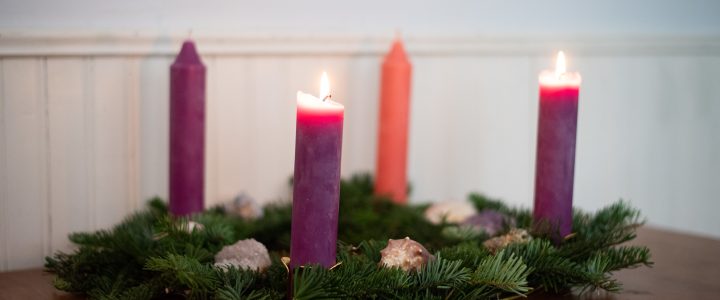
Advent is here again. This week, we’re meditating on the Mineral Kingdom, the world of the elements. Did you know: About 99 percent of the human body is made of just six elements? These are the very same elements that can be found throughout the Mineral Kingdom, in all the world’s “crystals, shells, and bones.”
We’re starting to build our Nativity Season Table this week by adding in some beautiful crystals, as well as our lovely Blessed Virgin Mary on her donkey. She will follow the star-lined path during the Advent season, leaving little roses in her wake as she passes.
Next week, we’ll add aspects of the Plant Kingdom to our little scene. Wishing you all a Blessed Advent!

A bare tree stands with roots at both ends . . .
—Kiran Bantawa
The world looks very different as the cold weather sets in and the plants and trees lose their leaves. This series of photographs attempts to capture both the emptiness and the complexity inherent in a leafless landscape. November is a great time for walking in nature. In the absence of foliage you can really see and study the lay of the land. You might be surprised by what you notice—things hidden and yet there all along.