
Vines, leaves, roots of darkness, growing,
now you are uncurled and cover our eyes
with the edge of winter sky
leaning over us in icy stars.
—from “Winter Solstice Chant” by Annie Finch
Most people are familiar with the four seasons of the year: Winter, spring, summer, and fall. In the Northern Hemisphere, the winter season officially begins at the solstice, the shortest day of the year (the 21st or 22nd of December). But there is another version of this season, and it’s called “solar winter.”
Solar winter begins about 45 days before the winter solstice and ends about 45 days after it. This period from early November to early February represents the three darkest months of the year. About the math: Because the year has 365 days, it can’t be divided into four perfectly even quadrants, but each solar season can be thought of as containing about 90 days (+/-). Ninety days divided in half, with the winter solstice as the midpoint, results in 45 days on either side.
With the winter solstice as the center point of solar winter, all the old songs and sayings about “midwinter” start to make a lot more sense. The liturgical calendar makes more sense too. Advent used to begin on November 11th, the feast of St Martin of Tours (or Martinmas), while the Christmas season technically runs until Candlemas on February 2nd. So, the span of the traditional Advent and Christmas seasons aligns closely with solar winter. If you back up slightly to All Saints’ and All Souls’ Days at the beginning of November, you get an almost perfect match.
Unfortunately, Daylight Saving Time (DST) has completely upended this natural rhythm, especially on the far end of solar winter. The early risers are all too aware that, just as the mornings are becoming light again in February, they make us “spring ahead” and the dawn hours become dark again. Likewise, just as the mornings are darkening in November, they suddenly become light again. That’s why I’m a standard time partisan!
DST was first used in the United States during WWI and WWII (it was called “War Time”) but was not made permanent until 1974. Of course, if we don’t “fall back” in November, by the end of December the sun is rising at almost 8:00 am. But that is the natural mood of the season. We could get used to it again.
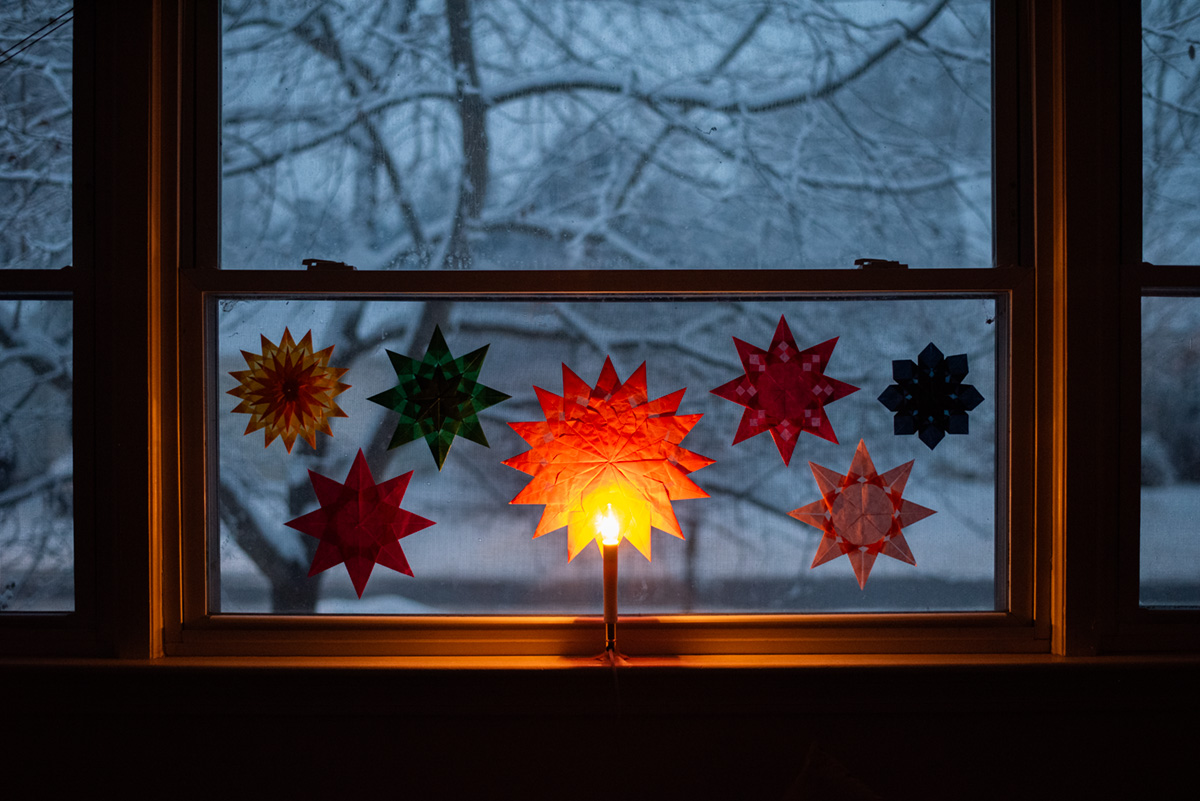
One way that I like to honor solar winter is by putting electric candles in the windows of our home—I usually install them on Martinmas and take them down after Candlemas. Because they are light sensitive, they turn on as the sun sets and turn off when it rises, without me having to think about it. This little bit of extra light during the darkest days of the year is such a gift. The glowing candles in our windows remind us, and all those who see them, that “The light shines in the darkness, and the darkness has not overcome it.” (John 1:5).